To find the location and cause of your bleeding, you'll have a physical exam. You'll be asked about your health history. Tests will be done to help confirm the diagnosis and plan your treatment.
Tests you may have
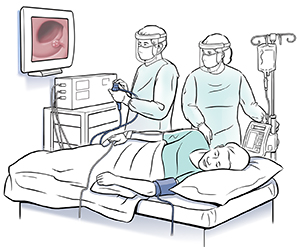
You will have blood work done. You may also have these tests:
-
Stool sample. A small amount of your stool will be checked for blood.
-
Anoscopy. This test uses a small tube (anoscope) to examine the anus. It checks for problems, such as hemorrhoids.
-
Sigmoidoscopy. This test uses a lighted tube to check your rectum and the part of the large intestine that's closest to the rectum (the sigmoid colon).
-
Colonoscopy. This procedure uses a long, flexible tube with a light and camera to check your rectum and entire colon. You will be given medicine through an I.V. (intravenous) line so you can sleep through the procedure.
-
Lower GI (gastrointestinal) series, orbarium enema. This is an X-ray test to view your colon. A milky liquid containing barium is passed through your rectum and into the colon. This liquid makes it easy to see your colon on the X-ray. This test is not done that often anymore.
-
Upper endoscopy. This test checks your esophagus, stomach, and upper small intestine. It's done in cases of rectal bleeding along with other symptoms like low blood pressure and rapid heartbeat. This test may also be done if your stools are dark black and look like tar.
-
Capsule endoscopy. For this test, you swallow a pill that has a tiny camera inside. The camera takes pictures of your small intestine. It can get to areas that are hard to reach with colonoscopy and upper endoscopy.
-
Balloon or spiral enteroscopy. These tests use a special tube (scope) to get deep into the small intestine.
-
Tagged red blood cell scan. This test marks (tags) red blood cells with very small amounts of radioactive material. The cells can then be seen and tracked on a scan.
-
Angiography. This test threads a tube (catheter) through a vein, often in the leg. Dye is injected through the tube into your blood vessels to see where the bleeding is taking place.
-
CT angiography. This test is a special type of CT scan that helps find the bleeding site.
Your treatment plan
Your treatment will depend on the cause of your rectal bleeding, as well as the severity of the bleeding. Your health care provider will create a treatment plan that’s right for you. Sometimes rectal bleeding stops on its own. Either way, be sure to see your provider to find the cause of the problem.
What you can do
Follow all your health care provider’s instructions. Keep working with your provider after your treatment. Make and go to your follow-up visits. If you have more rectal bleeding, call your provider right away. It may be a sign of the same or another health problem.
Online Medical Reviewer: Jen Lehrer MD
Online Medical Reviewer: Rita Sather RN
Online Medical Reviewer: Robyn Zercher FNP
Date Last Reviewed: 01/01/2025
© 2000-2026 The StayWell Company, LLC. All rights reserved. This information is not intended as a substitute for professional medical care. Always follow your healthcare professional's instructions.
Learn More About Health Services at PIH Health
Expert care for every stage of life. Explore the comprehensive services offered at PIH Health.
Explore Services
Get Health Tips & Updates
Sign up for helpful health information, wellness tips and news from PIH Health, delivered straight to your inbox.
SubscribeRelated Articles
Anal Cancer: Treatment Questions
Here is a list of questions to ask your healthcare provider about treatment for anal cancer.
What Is an Ileostomy?
During an ileostomy, healthcare providers either remove or disconnect your colon (large intestine), and sometimes part of the last section of your ileum (last section of your small intestine).
Treating Hemorrhoids: Removal
If your symptoms persist, your health care provider may recommend removing the hemorrhoid. This can be done in your provider's office or at a surgical center.
Treating Gallstones
The gallbladder is an organ that stores bile. This is a substance that helps with digestion. Deposits in bile can clump together, creating hard, pebble-like stones. Here is information on treatment choices.

Personalized Care Starts with the Right Provider
Search by specialty, location, and more.
Find A Doctor
Make an Appointment
Your health can't always wait. Schedule an appointment with a PIH Health provider.
Schedule an Appointment
Find a PIH Health Urgent Care Location
Need care today?. Find the nearest PIH Health Urgent Care location.
Find Urgent Care