What is cancer?
Cancer is when cells in the body grow out of control. To help you understand what happens when you have cancer, let's look at how your body works normally. Your body is made up of tiny building blocks called cells. Normal cells grow when your body needs them and die when your body does not need them any longer.
Cancer is made up of abnormal cells that grow even though your body doesn't need them. In most cancers, the abnormal cells form a lump or mass called a tumor. If cancer cells are in the body long enough, they can grow into (invade) nearby areas. They can even spread to other parts of the body (metastasis).
What is eye cancer?
Primary eye cancer is a very rare kind of cancer that starts somewhere in or on the eye (on the surface, on the iris, or within the eye beneath the retina) or in the skin around the eye (the eyelid). It's best to get treatment from an eye cancer specialist. Ask your doctor for a referral.
Types of eye cancer
There are different kinds of eye cancers. Below are some of the more common ones:
- Intraocular melanoma (uveal melanoma). This is the most common type of eye cancer. It often develops in the choroid or ciliary body.
- Intraocular lymphoma. This very rare type of lymphoma (typically non-Hodgkin) starts in the eyeball.
- Eyelid tumors. Basal cell carcinoma, a type of skin cancer, is the most common type of eyelid cancer. It can be removed with surgery. Other types of eyelid tumors include squamous cell carcinoma, sebaceous cell carcinoma, and malignant melanoma.
- Conjunctival tumors. These are tumors that grow on the surface of the eye. These tumors include squamous carcinomas, melanomas, and lymphomas.
- Lacrimal gland tumors. These tumors are found in the tear glands.
- Retinoblastoma. This cancer of the eye is the most common type in children. It's extremely rare in adults. These cancers begin in cells located in the back of the eye called the retina.
Understanding the eye
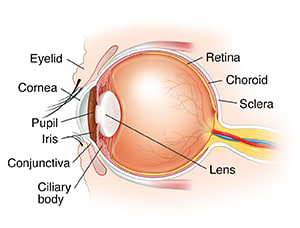
The eye is an organ that collects light and sends it to the brain. The brain turns this light from the eye into pictures that let you see. The eye is made up of many different parts:
- Eyelids. These keep the eyes moist and shield them from light.
- Conjunctiva. This membrane covers the front part of the eyeball and the inner surface of the eyelid. It lets the eyelid slide easily over the eye without irritating it.
- Sclera. This white outer layer of the eye covers the cornea and most of the outside of the eyeball.
- Cornea. This part in front of the eye is the clear window that helps focus light and covers and protects the iris.
- Iris. This is the colored part of the front of the eye. It adjusts the size of the opening in the middle of the iris (the pupil) to control the amount of light entering the eye.
- Retina. This part lines the inside of the eye. It does the work that helps people to see.
- Choroid. This part is a layer of blood vessels under the retina. The choroid feeds the retina. It also has cells in it called melanocytes. These cells can sometimes grow into a cancer called melanoma.
- Ciliary body. This part makes a watery fluid that is between the cornea and the iris. It also has muscles to control the shape of the lens. It does this to adjust to the distance of the objects you focus on.
- Uvea. This is a layer of tissue under the white of the eye (sclera). The uvea is made up of the choroid, the iris, and the ciliary body.
Talk with your doctor
If you have questions about eye cancer, talk with your doctor. Your doctor can help you understand more about this cancer.
Featured in
Date Last Reviewed: 09/01/2025
© 2026 The StayWell Company, LLC. All rights reserved. This information is not intended as a substitute for professional medical care. Always follow your healthcare provider's instructions.
Learn More About Health Services at PIH Health
Expert care for every stage of life. Explore the comprehensive services offered at PIH Health.
Explore Services
Get Health Tips & Updates
Sign up for helpful health information, wellness tips and news from PIH Health, delivered straight to your inbox.
SubscribeRelated Articles
Photodynamic Therapy (PDT) for Cancer
PDT is a treatment that uses medicines called photosynthesizing agents and light to destroy cancer cells. It is most often used to treat certain cancers in the esophagus, lungs, and skin. Learn more about PDT and what to expect.
Cancer Treatment: How to Pay for It
Even with insurance, cancer treatment can be expensive. Thankfully, there are resources that can help.
Chronic Myeloid Leukemia (CML): Phases
The phase of CML is important to know when deciding how to treat it. The phases note how many immature white blood cells (called blasts) are in the blood or bone marrow. Read on to learn more.
Hodgkin Lymphoma: Symptoms
Hodgkin lymphoma can have many different symptoms. Read on for a helpful look at some of the most common symptoms.

Personalized Care Starts with the Right Provider
Search by specialty, location, and more.
Find A Doctor
Make an Appointment
Your health can't always wait. Schedule an appointment with a PIH Health provider.
Schedule an Appointment
Find a PIH Health Urgent Care Location
Need care today?. Find the nearest PIH Health Urgent Care location.
Find Urgent Care