Each day that your blood pressure is too high, your chances of having a stroke are increased. Normal blood pressure is less than 120/80 millimeters of mercury (mmHg). This means systolic of less than 120 mmHg and diastolic of less than 80 mmHg. A stroke is a loss of brain function caused by a sudden lack of blood to part of the brain. Stroke can be caused by the damage that ongoing high blood pressure causes in your vessels. If the affected vessel stops supplying blood to the brain, a stroke happens.
How high blood pressure damages blood vessels
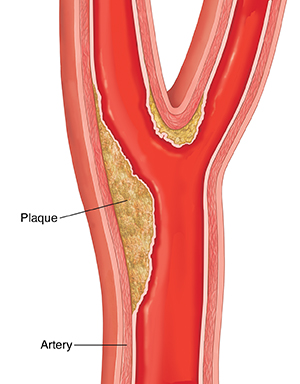
Vessels thicken
When blood presses against a vessel wall with too much force, muscles in the wall lose their ability to stretch. This causes the wall to thicken, which narrows the vessel passage and reduces blood flow.
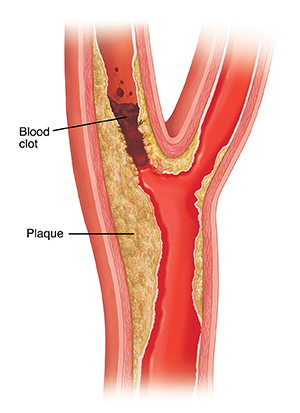
Clots form
When blood pressure is too high, it can damage blood vessel walls and create scar tissue. Fat and cholesterol (plaque) collect in the damaged spots. Blood cells stick to the plaque, forming a mass called a clot. A clot can block blood flow in the vessel.
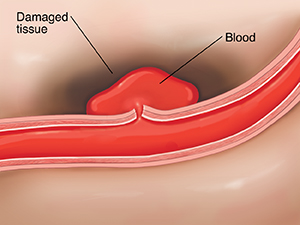
Vessels break
Sometimes, blood flows with enough force to weaken a vessel wall. If the vessel is small or damaged, the wall can break. When this happens, blood leaks into nearby tissue and kills cells. Other cells may die because blood cannot reach them.
Know the symptoms of stroke
During a stroke, blood supply to the brain is suddenly cut off. But with fast medical help, a better recovery is more likely. Don’t wait. Call 911 if you have any of these:
-
Sudden weakness or numbness on one side of the face or body, including a leg or an arm
-
Sudden trouble seeing with one or both eyes
-
Sudden double vision
-
Sudden trouble talking, such as slurred speech
-
Sudden severe headache
-
Sudden problems using or understanding words
-
Sudden confusion
-
Sudden dizziness or loss of balance
-
Seizures for the first time
-
Any of these symptoms that happen and then go away
Online Medical Reviewer: Anne Fetterman RN BSN
Online Medical Reviewer: Mary Mancini MD
Online Medical Reviewer: Raymond Kent Turley BSN MSN RN
Date Last Reviewed: 09/01/2025
© 2000-2026 The StayWell Company, LLC. All rights reserved. This information is not intended as a substitute for professional medical care. Always follow your healthcare professional's instructions.
Learn More About Health Services at PIH Health
Expert care for every stage of life. Explore the comprehensive services offered at PIH Health.
Explore Services
Get Health Tips & Updates
Sign up for helpful health information, wellness tips and news from PIH Health, delivered straight to your inbox.
SubscribeRelated Articles
The Lowdown on Low Blood Pressure
Doctors often consider chronically low blood pressure too low only if it drops suddenly or causes noticeable symptoms.
Coronary Artery Spasm
Coronary artery spasm is a type of angina. Angina is pain that is caused by the heart muscles not getting enough blood. A sudden spasm or narrowing of a blood vessel that supplies the heart causes angina by reducing the amount of oxygen the heart receives. Coronary artery spasms often cause pain. Sometimes severe spasms can lead to irregular heartbeats. They can even cause heart attack, also known as acute myocardial infarction, and sudden death.
Basic Anatomy of the Heart
Located almost in the center of the chest, the adult human heart is about the size of a fist. It pumps blood throughout the body.
Your Heart’s Electrical System
A helpful guide to how your heart's electrical system works, complete with a diagram.
Personalized Care Starts with the Right Provider
Search by specialty, location, and more.
Find A Doctor
Make an Appointment
Your health can't always wait. Schedule an appointment with a PIH Health provider.
Schedule an Appointment
Find a PIH Health Urgent Care Location
Need care today?. Find the nearest PIH Health Urgent Care location.
Find Urgent Care