If you have a tracheostomy tube
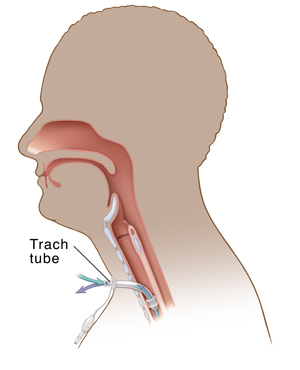
Your tracheostomy (trach) tube has been chosen to fit well and work right for you. You’ll learn how to keep it clean and clear. Often, a trach tube is needed for only a short time. Your surgeon will tell you how long to use the tube. If you don’t need a new airway after surgery, the hole in the front of your throat will close on its own after the trach tube has been removed. You will have a dressing over the site while it heals. In some cases, surgery is needed to close the hole.
If you have a stoma
Your larynx may have been removed during surgery. If so, you’ll continue to breathe through the hole in your throat. This hole is called a stoma. It's also called a permanent tracheostomy. Tell those who care for you that this is your only airway. In a medical emergency, a breathing tube can't be put in through your nose or mouth. You will be shown how to care for your stoma. Support groups can help you get used to having a new airway. And you can return to work, family life, and many of the activities you did before surgery.
You will need follow-up visits for your tracheostomy and its care.
When to contact your doctor
Contact your doctor right away if you have:
-
A red or painful stoma.
-
A small amount of bleeding, that stops promptly, from the tube or stoma.
-
Yellow, smelly, bloody, or thick mucus around or inside your stoma.
-
Pain while cleaning your airway.
-
A persistent cough.
Call 911
Call
-
Trouble breathing or wheezing
-
Coughing up blood
-
Large amount of bleeding, or persistent bleeding, from the tracheostomy site
-
Swelling around the trach tube or stoma
Online Medical Reviewer: Jessica Gotwals RN BSN MPH
Online Medical Reviewer: Mary Mancini MD
Online Medical Reviewer: Ronald Karlin MD
Date Last Reviewed: 06/01/2025
© 2000-2026 The StayWell Company, LLC. All rights reserved. This information is not intended as a substitute for professional medical care. Always follow your healthcare professional's instructions.
Learn More About Health Services at PIH Health
Expert care for every stage of life. Explore the comprehensive services offered at PIH Health.
Explore Services
Get Health Tips & Updates
Sign up for helpful health information, wellness tips and news from PIH Health, delivered straight to your inbox.
SubscribeRelated Articles
After a Thoracoscopy
Here is what to expect after a thoracoscopy. Learn about recovering in the hospital and how to care for yourself at home.
Continuous Positive Airway Pressure (CPAP)
A CPAP device helps you breathe better at night. The device delivers air through your nose or mouth when you breathe in to keep your air passages open.
Discharge Instructions for Thoracentesis
Thoracentesis is a procedure that removes extra fluid from the pleural space. This space is between the outside surface of the lungs (pleura) and the chest wall.
Discharge Instructions for Emphysema
Here is home care information for after you're diagnosed with emphysema.

Personalized Care Starts with the Right Provider
Search by specialty, location, and more.
Find A Doctor
Make an Appointment
Your health can't always wait. Schedule an appointment with a PIH Health provider.
Schedule an Appointment
Find a PIH Health Urgent Care Location
Need care today?. Find the nearest PIH Health Urgent Care location.
Find Urgent Care