In the womb, your baby gets oxygen from your placenta. Since your baby doesn’t have to breathe, their lungs are filled with fluid. During and after birth, some of this fluid is pushed out. The baby's lung tissue absorbs the rest. Transient tachypnea (TTN) happens when too much fluid is left behind in the lungs after the birth. It's also called retained fetal lung fluid. TTN makes it hard for the baby to take in air in their lungs. Your baby breathes harder and faster to get enough air. The main symptom of TTN is tachypnea (rapid breathing, more than 60 breaths per minute for a newborn). Transient means passing with time. A newborn usually has TTN for only a short time.
How is TTN diagnosed?
A health care provider may first listen to the baby’s chest or breathing pattern. A chest X-ray can often find excess fluid in the lungs. Your provider can also check the X-ray to make sure that there are no other problems that may be causing trouble breathing. Providers measure the level of oxygen in the baby’s blood. They use a device (pulse oximeter) taped to the baby’s hand or foot. They may also do a blood test. The pulse oximeter or blood test shows whether the baby needs extra oxygen.
What are the treatments for TTN?
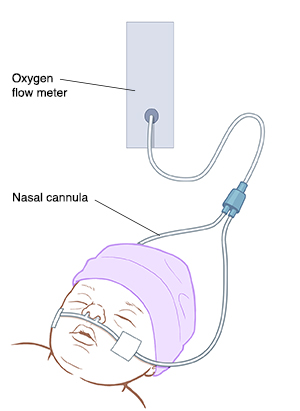
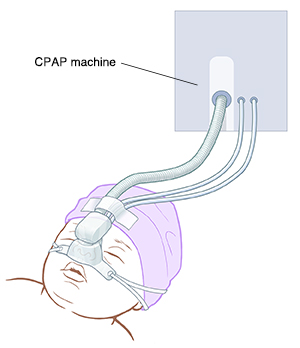
Health care providers check your baby’s pulse, breathing, and blood oxygen levels. This helps to make sure these levels are in a safe range. Your baby may be given oxygen using:
-
A nasal cannula (soft tubes fixed under the baby’s nostrils).
-
An oxygen hood (a clear plastic box that fits around the baby’s head).
-
A CPAP (continuous positive airway pressure) machine. This machine pushes a small amount of air continuously into the baby’s lungs. It helps hold open the airways and clear fluid. The air is blown through a mask that goes over the baby's nose or small plastic tongs that goes into the baby's nose. CPAP may be used with or without supplemental oxygen.
What are the long-term effects?
In most cases, TTN causes no further problems and clears up within 72 hours. Breastfeeding or bottle feeding may not be possible until your baby is able to breathe normally. There are no known long-term effects on your baby’s lungs. Your baby’s health care provider can tell you more about your baby’s specific situation.
Featured in
Online Medical Reviewer: Donna Freeborn PhD CNM FNP
Online Medical Reviewer: Liora C Adler MD
Online Medical Reviewer: Stacey Wojcik MBA BSN RN
Date Last Reviewed: 02/01/2025
© 2000-2026 The StayWell Company, LLC. All rights reserved. This information is not intended as a substitute for professional medical care. Always follow your healthcare professional's instructions.
Learn More About Health Services at PIH Health
Expert care for every stage of life. Explore the comprehensive services offered at PIH Health.
Explore Services
Get Health Tips & Updates
Sign up for helpful health information, wellness tips and news from PIH Health, delivered straight to your inbox.
SubscribeRelated Articles
Transient Tachypnea of the Newborn
Transient tachypnea of the newborn is a breathing problem that affects babies during the first hours of life. Transient means it is short-lived. Tachypnea means fast breathing rate. The problem often goes away on its own in about 3 days.
Small for Gestational Age
Small for gestational age is a term used to describe babies that are smaller than normal for the number of weeks of pregnancy. These babies have birth weight below the 10th percentile. This means they are smaller than many other babies of the same gestational age.
Equipment You May See in the NICU
Here is detailed information about the different equipment you may find in the NICU.
Birth Defects in Children
A birth defect is a health problem or abnormal physical change that is present when a baby is born. Birth defects can be very mild, where the baby looks and acts like any other baby. Or birth defects can be more severe. Read on to learn more.
Personalized Care Starts with the Right Provider
Search by specialty, location, and more.
Find A Doctor
Make an Appointment
Your health can't always wait. Schedule an appointment with a PIH Health provider.
Schedule an Appointment
Find a PIH Health Urgent Care Location
Need care today?. Find the nearest PIH Health Urgent Care location.
Find Urgent Care