Having your uterus (womb) removed is called a hysterectomy. Using a method called laparoscopy has many benefits. You may spend less time in the hospital and recover faster.
What is hysterectomy?
Hysterectomy removes the uterus. Part or all of the uterus may be taken out. Certain other organs may be removed at the same time. Having your uterus removed means that you won't menstruate (have periods) and you won’t be able to get pregnant in the future.
Uterus removal is a common treatment for a variety of conditions that affect a woman's reproductive organs.
What is laparoscopy?
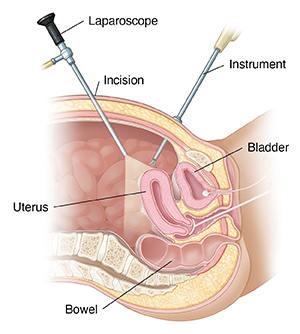
Laparoscopy is a type of surgery. A long, lighted tube with a camera is used. This is called a laparoscope. The scope sends pictures of the inside of the body to a video screen. For the surgery, a few small incisions are made in the belly (abdomen). The scope is inserted through one of the small incisions. Surgical tools are inserted through the other incisions to complete the procedure.
Benefits of laparoscopy
This procedure is done instead of open surgery. Open surgery needs a larger incision in the abdomen. Compared with open surgery, laparoscopy may:
-
Need less time in the hospital or surgery center.
-
Offer a faster recovery.
-
Cause less internal scarring and smaller visible scars.
-
Cause less pain after surgery.
-
Have a lower risk of complications.
Risks and possible problems from laparoscopic hysterectomy
-
Side effects from anesthesia
-
Infection
-
Bleeding, with a possible need for a transfusion
-
Blood clots
-
Damage to the bladder, bowel, ureters, or nearby nerves
-
Hernia
-
Formation of scar tissue that can cause pain or bowel obstruction, often years later
-
Need for a second surgery
Featured in
Online Medical Reviewer: Daphne Pierce-Smith RN MSN
Online Medical Reviewer: Rajadurai Samnishanth Researcher
Online Medical Reviewer: Raymond Turley Jr PA-C
Date Last Reviewed: 03/01/2025
© 2000-2026 The StayWell Company, LLC. All rights reserved. This information is not intended as a substitute for professional medical care. Always follow your healthcare professional's instructions.
Learn More About Health Services at PIH Health
Expert care for every stage of life. Explore the comprehensive services offered at PIH Health.
Explore Services
Get Health Tips & Updates
Sign up for helpful health information, wellness tips and news from PIH Health, delivered straight to your inbox.
SubscribeRelated Articles
Stress Urinary Incontinence: Having Retropubic Suspension Surgery
Retropubic suspension is a type of surgery to treat stress urinary incontinence. Read on for helpful details about the surgery and what to expect.
Pelvic Organ Prolapse: Surgery for Cystocele
Cystocele is when the bladder sags into the vagina. The goal of surgery is to repair the problem and relieve symptoms.
Tubal Sterilization Surgery
Tubal sterilization is one of the most effective forms of birth control. It blocks the egg from being fertilized by sperm. This prevents pregnancy.
Pelvic Organ Prolapse: Surgery for Incontinence
Urinary incontinence (urine leakage) can be treated during pelvic organ prolapse surgery. The goal of surgery is to hold the urethra and bladder firmly in place to prevent leakage and relieve your symptoms.

Personalized Care Starts with the Right Provider
Search by specialty, location, and more.
Find A Doctor
Make an Appointment
Your health can't always wait. Schedule an appointment with a PIH Health provider.
Schedule an Appointment
Find a PIH Health Urgent Care Location
Need care today?. Find the nearest PIH Health Urgent Care location.
Find Urgent Care