The urinary system includes the kidneys, ureters, bladder, and urethra. This body system makes, stores, and gets rid of liquid waste called urine. The two kidneys filter blood to collect waste and make urine. The two ureters are small tubes that carry urine from each kidney to the bladder. The bladder is where urine is stored before it leaves the body. The urethra is the tube that urine goes through to leave the body.
Bladder cancer means that cells in the bladder have changed in ways that aren't normal.
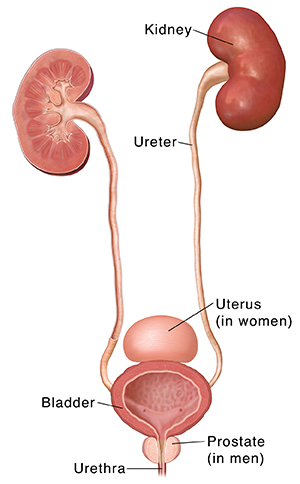
When bladder cancer forms
Cancer starts when cells change (mutate) and grow out of control. The dividing cells may form a lump of tissue (tumor ). With time, the cancer cells destroy healthy bladder tissue. They may spread to other parts of the body.
Why some cells become cancer is not always clear. But bladder cancer is strongly linked to cigarette smoking. In fact, smoking is linked to about half of all bladder cancers. The longer a person smokes and the more a person smokes, the greater that person’s chances of developing bladder cancer.
Types of cancer that may form
Most bladder cancers are urothelial carcinomas, also called transitional cell carcinomas. They start in the cells that make up the lining inside of the bladder. Bladder cancer may grow in different ways:
-
Papillary tumors. These stick out from the bladder lining on a stalk. They tend to grow toward the bladder cavity, away from the bladder wall, instead of deeper into the layers of the bladder wall.
-
Flat or sessile tumors. These don't stick out from the bladder lining. These tumors are much more likely than papillary tumors to grow into the deeper layers of the bladder wall.
-
Carcinoma in situ. This is a patch of flat tumor cancer cells that's only in the inner layer of the bladder lining and has not spread to deeper layers. The patch may look almost normal. Or it may look inflamed and red.
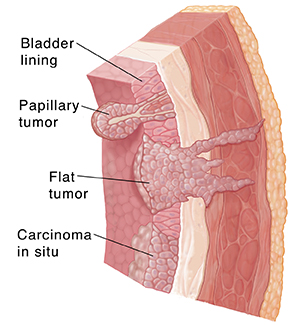
Each type of tumor can be found in more than one part of the bladder. And more than one type can form at the same time.
Featured in
Online Medical Reviewer: Jessica Gotwals RN BSN MPH
Online Medical Reviewer: Raymond Turley Jr PA-C
Online Medical Reviewer: Todd Gersten MD
Date Last Reviewed: 09/01/2025
© 2000-2026 The StayWell Company, LLC. All rights reserved. This information is not intended as a substitute for professional medical care. Always follow your healthcare professional's instructions.
Learn More About Health Services at PIH Health
Expert care for every stage of life. Explore the comprehensive services offered at PIH Health.
Explore Services
Get Health Tips & Updates
Sign up for helpful health information, wellness tips and news from PIH Health, delivered straight to your inbox.
SubscribeRelated Articles
Stomach Cancer: Introduction
Learn the basics about stomach cancer.
Nonmelanoma Skin Cancer: Introduction
Cancer starts when cells in the body change and grow out of control. Some cells may spread into nearby tissues or other parts of the body. This is called metastasis. Nonmelanoma is the most common type of skin cancer. It is successfully treated if found early. Read on to learn more.
Soft Tissue Sarcoma: Overview
Here are answers to some frequently asked questions about soft tissue sarcoma.
Carcinoma of Unknown Primary: Overview
In carcinoma of unknown primary (CUP), doctors can’t tell where the cancer started. CUP has already spread by the time it’s diagnosed. Learn more about symptoms, diagnosis, and treatments.

Personalized Care Starts with the Right Provider
Search by specialty, location, and more.
Find A Doctor
Make an Appointment
Your health can't always wait. Schedule an appointment with a PIH Health provider.
Schedule an Appointment
Find a PIH Health Urgent Care Location
Need care today?. Find the nearest PIH Health Urgent Care location.
Find Urgent Care