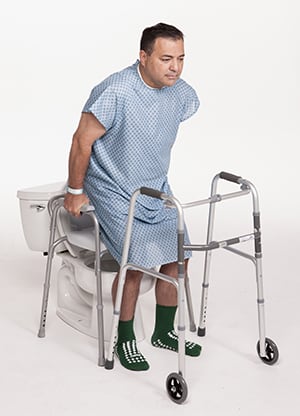
Using the bathroom can be challenging after hip surgery. Follow your “hip precautions” and the tips on this sheet to keep your new hip safe when using the toilet.
- Back up until you feel the toilet touch the back of your legs.
- Place your operated leg in front of you, keeping your weight on the other leg.
- Look behind you and grasp the grab bar (or side rails, if you're using a toilet with rails).
- Lower yourself onto the front of the toilet, then scoot back.
- To get up, reverse these steps.
- If you have a low toilet seat at home, your doctor may prescribe an elevated toilet seat lift.
Remember your hip precautions
- Don't bend your hip at the waist more than 90°. (Don't move your knees and chest too far toward each other.)
- Don't cross your legs or ankles or let your operated thigh cross the middle of your body.
- Don't turn your operated hip or knee inward.
Online Medical Reviewer: L Renee Watson MSN RN
Online Medical Reviewer: Raymond Turley Jr PA-C
Online Medical Reviewer: Thomas N Joseph MD
Date Last Reviewed: 07/01/2023
© 2000-2026 The StayWell Company, LLC. All rights reserved. This information is not intended as a substitute for professional medical care. Always follow your healthcare professional's instructions.
Learn More About Health Services at PIH Health
Expert care for every stage of life. Explore the comprehensive services offered at PIH Health.
Explore Services
Get Health Tips & Updates
Sign up for helpful health information, wellness tips and news from PIH Health, delivered straight to your inbox.
SubscribeRelated Articles
Back Safety: Pushing and Pulling
Pushing can be hard on your back, but pulling can be even harder. So, push rather than pull when you can.
Conditioning Before Knee Replacement
Conditioning your body BEFORE knee replacement can help speed your recovery. Daily exercise helps strengthen muscles that support the knee joint.
Plaster Splint Care
Here are directions to care for your splint at home.
Wearing a Rib Belt
A rib belt is an elastic strap that may help reduce pain from chest muscle strain or rib fracture.
Personalized Care Starts with the Right Provider
Search by specialty, location, and more.
Find A Doctor
Make an Appointment
Your health can't always wait. Schedule an appointment with a PIH Health provider.
Schedule an Appointment
Find a PIH Health Urgent Care Location
Need care today?. Find the nearest PIH Health Urgent Care location.
Find Urgent Care