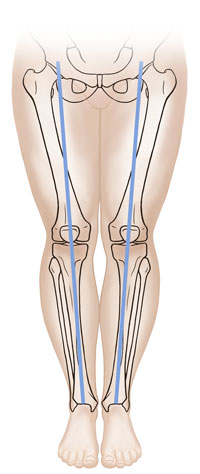
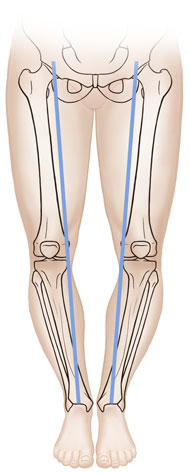
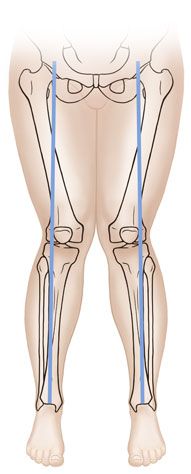
If your child’s legs aren’t completely straight, they may have bowlegs or knock knees. They may look familiar because, many times, the way a child’s legs are shaped is similar to the way their parents’ legs were shaped. Bowlegs and knock knees are common in young children but usually go away as the child grows.
If your child’s legs aren’t straight
If your child’s legs curve outward, they have bowlegs. If your child’s knees come together and the lower legs point outward, they have knock knees. Often, a child will start out with bowlegs, the legs may straighten, then the child may become knock-kneed. Your healthcare provider will examine your child’s legs and may X-ray them to make sure there isn’t a structural problem.
Caring for your child
Bowlegs and knock knees almost always correct themselves as your child reaches adolescence. So, if you wait it out, you’ll probably notice that, over time, the curves become less and less noticeable.
Surgery
If the curves in your child’s legs are getting progressively worse, causing pain or limitations, which is rare, braces or surgery may be recommended. These help straighten your child’s legs and prevent future problems.
Online Medical Reviewer: Rahul Banerjee MD
Online Medical Reviewer: Raymond Turley Jr PA-C
Online Medical Reviewer: Rita Sather RN
Date Last Reviewed: 05/01/2024
© 2000-2026 The StayWell Company, LLC. All rights reserved. This information is not intended as a substitute for professional medical care. Always follow your healthcare professional's instructions.
Learn More About Health Services at PIH Health
Expert care for every stage of life. Explore the comprehensive services offered at PIH Health.
Explore Services
Get Health Tips & Updates
Sign up for helpful health information, wellness tips and news from PIH Health, delivered straight to your inbox.
SubscribeRelated Articles
Back Safety: Sitting
Sitting can strain your back if you don't do it right. Learn the right moves to protect your back.
Self-Care for Strains and Sprains
Most minor strains and sprains can be treated with self-care. But if you have torn tissue or damaged blood vessels, nerves, or bones, be sure to call your healthcare provider.
Colles Wrist Fracture, No Reduction Needed
You have a break (fracture) of the forearm bone (radius) where it attaches to your wrist. It may be called a Colles fracture. The bone isn't out of place and won't need to be set (reduced). But you'll need a splint or cast.
Leg Muscle Stretches: Knee Flexion
The following flexibility exercise may be suggested by your therapist. Repeat as many times as instructed. Stop the exercise if it causes pain, and discuss it with your physical therapist or healthcare provider:

Personalized Care Starts with the Right Provider
Search by specialty, location, and more.
Find A Doctor
Make an Appointment
Your health can't always wait. Schedule an appointment with a PIH Health provider.
Schedule an Appointment
Find a PIH Health Urgent Care Location
Need care today?. Find the nearest PIH Health Urgent Care location.
Find Urgent Care