Your healthcare team will keep track of your progress after your surgery. During the surgery, you may receive general anesthesia (puts you to sleep), an epidural nerve block in your spinal canal (numbs you from the waist down), or a femoral nerve block in your leg (numbs your whole leg). Sometimes the femoral nerve block is added to another anesthesia for better sedation and pain control. Your team will use support equipment to help you recover. Be sure to let them know how you feel and how well your pain is controlled. You may also receive medicines, such as antibiotics and blood thinners.
Support equipment
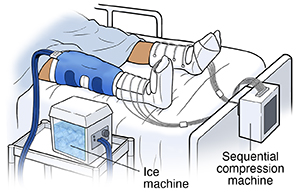
Special tubes and machines help you recover after surgery. They may include:
-
An IV (intravenous) line to provide needed fluids and medicines
-
A tube (catheter) to help drain your bladder
-
A drainage tube in your leg to remove excess fluid that may build up, and to reduce swelling
-
An ice machine or ice pack to reduce pain and inflammation that carries cold water to the knee joint
-
A sequential compression machine to prevent blood clots by gently squeezing and then releasing your foot or calf
-
A continual passive motion machine may be advised to increase flexibility by gently moving your knee
Managing pain
When pain is controlled, you’ll walk sooner and recover faster. So be honest about how much pain you feel. And don’t be afraid to ask for pain medicine when you need it. Your nurse may give you pain medicine by IV (intravenous) line into your hand or arm, or by mouth (orally) while in the hospital. You will be given a pain pill prescription for use at home. patient-controlled analgesia Tell your nurse if the medicines don’t reduce pain or if you suddenly feel worse.
Featured in
Online Medical Reviewer: Rahul Banerjee MD
Online Medical Reviewer: Raymond Turley Jr PA-C
Online Medical Reviewer: Rita Sather RN
Date Last Reviewed: 04/01/2024
© 2000-2026 The StayWell Company, LLC. All rights reserved. This information is not intended as a substitute for professional medical care. Always follow your healthcare professional's instructions.
Learn More About Health Services at PIH Health
Expert care for every stage of life. Explore the comprehensive services offered at PIH Health.
Explore Services
Get Health Tips & Updates
Sign up for helpful health information, wellness tips and news from PIH Health, delivered straight to your inbox.
SubscribeRelated Articles
Understanding Leg Amputation: Surgery After Injury
Amputation is a surgery to remove part or all of your leg. It's done because tissue in the leg is damaged and can't be healed. Read on to learn about the procedure, and what to expect afterward.
Protecting Your Foot After Foot Surgery
To help the bone heal properly, you may need to wear a cast. If you do, always keep it dry. Your healthcare provider will tell you whether you can bear weight on your foot while it heals. They may also prescribe a surgical shoe for you to wear.
Managing Pain After Amputation Surgery
You may have different types of pain after amputation. Talk with your doctor about your pain to get the best treatment.
Discharge Instructions for Total Hip Replacement Surgery
This sheet will help you care for yourself after total hip replacement.

Personalized Care Starts with the Right Provider
Search by specialty, location, and more.
Find A Doctor
Make an Appointment
Your health can't always wait. Schedule an appointment with a PIH Health provider.
Schedule an Appointment
Find a PIH Health Urgent Care Location
Need care today?. Find the nearest PIH Health Urgent Care location.
Find Urgent Care