Reverse total shoulder replacement is a type of shoulder surgery. It’s usually done to repair the shoulder joint if you have a completely torn rotator cuff with shoulder arthritis.
Understanding the shoulder joint
The shoulder joint is where the ball-shaped part of the upper arm bone (humerus) meets the cup-shaped socket of the shoulder blade (scapula). A group of muscles and tendons hold the joint together. These muscles and tendons are called the rotator cuff. The muscles let you move your arm and shoulder.
Why reverse total shoulder replacement is done
The surgery may be needed if you have a complete tear of your rotator cuff. The tear may cause long-term problems with your shoulder joint. This is called cuff tear arthropathy. You may need reverse total shoulder replacement surgery if you have:
-
A complete tear in your rotator cuff.
-
Joint problems from the cuff tear (cuff tear arthropathy).
-
Symptoms that didn't go away after a previous total shoulder replacement surgery.
-
Severe pain and trouble moving your shoulder.
-
No relief with treatments such as rest, medicines, cortisone injections, or physical therapy.
How reverse total shoulder replacement is done
The surgery is the opposite (reverse) of standard total shoulder replacement surgery:
-
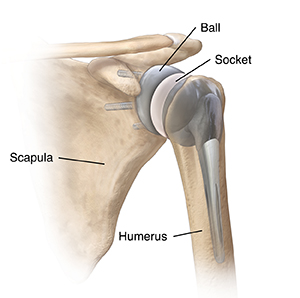
In the standard surgery, the ball of the humerus is replaced with an artificial ball. The socket of the scapula is replaced with an artificial socket. The new joint still uses the rotator cuff muscles to move the arm and shoulder.
-
With the reverse surgery, the ball of the humerus is replaced with an artificial socket. The socket of the scapula is replaced with an artificial ball. Since the rotator cuff muscles are damaged, another muscle (deltoid) moves the arm and shoulder.
Risks of reverse total shoulder replacement
Every surgery has risks. Risks for this surgery include:
-
Infection.
-
Blood loss.
-
Damage to nerves that may make it hard to move your arm.
-
Damage to the humerus or scapula.
-
The artificial joint moving out of position (dislocation).
-
Stiffness, pain, and limited function.
-
Problems with anesthesia.
Some risks may be higher if you've had shoulder surgery in the past. Your risks may vary depending on your shoulder problem and your overall health. Talk with your doctor about which risks apply most to you.
Online Medical Reviewer: Raymond Turley Jr PA-C
Online Medical Reviewer: Tara Novick BSN MSN
Online Medical Reviewer: Thomas N Joseph MD
Date Last Reviewed: 05/01/2025
© 2000-2026 The StayWell Company, LLC. All rights reserved. This information is not intended as a substitute for professional medical care. Always follow your healthcare professional's instructions.
Learn More About Health Services at PIH Health
Expert care for every stage of life. Explore the comprehensive services offered at PIH Health.
Explore Services
Get Health Tips & Updates
Sign up for helpful health information, wellness tips and news from PIH Health, delivered straight to your inbox.
SubscribeRelated Articles
Understanding Minimally Invasive Total Knee Replacement
Total knee replacement is a type of surgery to replace a damaged knee joint. It is done by an orthopedic surgeon.
Having Arm Fracture Open Reduction and Internal Fixation (ORIF)
Open reduction and internal fixation (ORIF) is a type of treatment to fix a broken bone. It puts the pieces of a broken bone back together so they can heal.
Before Total Hip Replacement: Preparing for Your Recovery
You may be nervous about getting a new hip. But the better prepared you are before surgery, the easier your recovery program is likely to be.
Understanding Leg Amputation: Surgery for a Medical Condition
This surgery removes part or all your leg. It is done because tissue in the leg is diseased and can't be healed. Or it may be needed to prevent the disease from spreading farther into your body. The goal of the surgery is to restore your ability to function. This is because removing the diseased part of your leg can improve your total health.

Personalized Care Starts with the Right Provider
Search by specialty, location, and more.
Find A Doctor
Make an Appointment
Your health can't always wait. Schedule an appointment with a PIH Health provider.
Schedule an Appointment
Find a PIH Health Urgent Care Location
Need care today?. Find the nearest PIH Health Urgent Care location.
Find Urgent Care