Total hip replacement surgery almost always reduces joint pain. During this surgery, your problem hip joint is replaced with an artificial joint, called a prosthesis.
Benefits of hip replacement
Total hip replacement surgery almost always:
-
Stops or greatly reduces hip pain. Even the pain from surgery should go away within weeks.
-
Increases leg function. Without hip pain, you’ll be able to use your legs more. This will build up your muscles.
-
Improves quality of life by allowing you to do daily tasks and low-impact activities in greater comfort.
-
Provides years of easier movement. Most total hip replacements last for many years.
Your surgical experience
You will most likely arrive at the hospital on the morning of surgery. In many cases, pre-op tests are done days or even weeks ahead of time. Follow all of your surgeon’s instructions on preparing for surgery. When you arrive, you’ll be given forms to fill out. You will also talk with the anesthesiologist, the healthcare provider who gives the anesthesia, if you haven’t done so already.
Preparing for surgery
Follow any directions you are given for taking medicines or for not eating or drinking before surgery. You may need to stop certain medicines several days or weeks before the surgery. At the hospital your temperature, pulse, breathing, and blood pressure will be checked. An IV (intravenous) line will be started to provide fluids and medicines needed during surgery.
The surgical procedure
When the surgical team is ready, you’ll be taken to the operating room. There you’ll be given anesthesia. The anesthesia will help you sleep through surgery, or it will make you numb from the waist down. Then an incision is made, giving the surgeon access to your hip joint. The damaged ball is removed, and the socket is prepared to hold the prosthesis. After the new joint is in place, the incision is closed with staples or stitches.
Preparing the bone
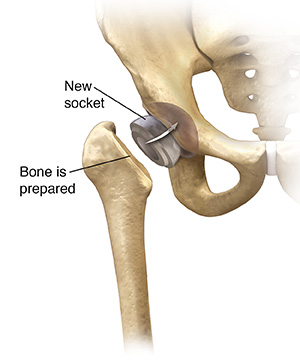
The hip is a ball-and-socket joint. The ball is cut from the thighbone, and the surface of the old socket is smoothed. Then the new socket is put into the pelvis. The socket is usually press-fit and may be held in place with screws. A press-fit prosthesis has tiny pores on its surface that your bone will grow into. Cement or press-fit may be used to hold the ball-and-stem portion of the hip replacement.
Joining the new parts
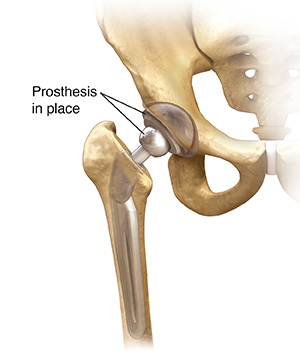
The new hip stem is inserted into the upper portion of your thighbone. After the stem is secure in the thighbone, the new ball and socket are joined. The stem of the prosthesis may be held with cement or press-fit. Your surgeon will choose the method that is best for you.
In the recovery room
After surgery you’ll be sent to the recovery room, also called the PACU (postanesthesia care unit). Your condition will be watched closely, and you’ll be given pain medicine. You may have a catheter (small tube) in your bladder and a drain in your hip. To keep your new joint stable, a foam wedge or pillows may be placed between your legs. In some cases, a brace is used.
Risks and complications
As with any surgery, hip replacement has possible risks and complications. These include:
-
Reaction to the anesthesia
-
Blood clots
-
Infection
-
Dislocation of the joint or loosening of the prosthesis
-
Difference in leg length
-
Fracture
-
Wearing out the prosthetic
-
Damage to nearby blood vessels, bones, or nerves
-
Thigh pain
Online Medical Reviewer: Joseph, Thomas N., MD
Online Medical Reviewer: Walton-Ziegler, Olivia, MS, PA-C
Date Last Reviewed: 09/01/2025
© 2000-2026 The StayWell Company, LLC. All rights reserved. This information is not intended as a substitute for professional medical care. Always follow your healthcare professional's instructions.
Learn More About Health Services at PIH Health
Expert care for every stage of life. Explore the comprehensive services offered at PIH Health.
Explore Services
Get Health Tips & Updates
Sign up for helpful health information, wellness tips and news from PIH Health, delivered straight to your inbox.
SubscribeRelated Articles
Treating Ankle Fractures
Treatment depends on where and how badly your ankle has been broken. A cast may be used to hold the bone in position for healing.
Before Arthroscopy
Here's what to know before you have arthroscopy.
Treating Charcot Foot
If you have Charcot foot, you will need to stay off your foot until it heals.
Foot Surgery: Curled Fifth Toe
A curled fifth toe is most often inherited. When the fifth toe curls inward, it moves under the next toe. Then the nail of the curled toe starts to face outward. As a result, you may bear weight on the side of your toe instead of the bottom. This can cause corns and painful nails. There are many nonsurgical treatments available. But if these are not effective, surgery is a choice.

Personalized Care Starts with the Right Provider
Search by specialty, location, and more.
Find A Doctor
Make an Appointment
Your health can't always wait. Schedule an appointment with a PIH Health provider.
Schedule an Appointment
Find a PIH Health Urgent Care Location
Need care today?. Find the nearest PIH Health Urgent Care location.
Find Urgent Care