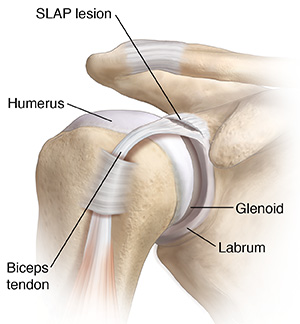
The shoulder is the most mobile joint in your body. The ball or “head” of the arm bone (humerus) rests in a shallow rounded socket called the glenoid. To help make the socket deeper, the outer rim of the glenoid is ringed by tough, flexible tissue called the labrum.
What Is a SLAP Lesion?
SLAP stands for superior labrum anterior to posterior. This means that the upper rim of the labrum has been torn from front to back. The tear happens where the biceps tendon attaches to the labrum. Common causes of a SLAP lesion include:
-
Falling on an outstretched hand
-
Forceful lifting or pulling on the arm, such as trying to catch a heavy object
-
Repeated overhead motions (such as throwing)
-
Shoulder dislocation
Diagnosing a SLAP lesion
To diagnose the problem, your healthcare provider will check your arm and shoulder. This includes moving your arm in certain directions to test for symptoms. You may also have imaging tests such as an X-ray, MRI, or CT scan. They may be done to evaluate the lesion and to look for other injuries such as breaks (fractures) or rotator cuff tears. These provide your provider with a detailed view of the tissues inside your shoulder joint.
Treating a SLAP lesion
Rest and anti-inflammatory medicines are often the first line of treatment. Injections of steroid medicine may be used. Physical therapy can also be used to strengthen the muscles in the shoulder. This helps keep the joint stable. If these treatments aren’t enough, your provider may advise surgery to repair the labrum.
Online Medical Reviewer: Fetterman, Anne, RN, BSN
Online Medical Reviewer: Joseph, Thomas N., MD
Date Last Reviewed: 04/01/2024
© 2000-2026 The StayWell Company, LLC. All rights reserved. This information is not intended as a substitute for professional medical care. Always follow your healthcare professional's instructions.
Learn More About Health Services at PIH Health
Expert care for every stage of life. Explore the comprehensive services offered at PIH Health.
Explore Services
Get Health Tips & Updates
Sign up for helpful health information, wellness tips and news from PIH Health, delivered straight to your inbox.
SubscribeRelated Articles
Understanding Plantar Fasciitis
Plantar fasciitis is a condition that causes foot and heel pain. Learn more about it, including symptoms, causes, and treatment.
Joint Dislocation
You have a joint dislocation. This happens when a strong force is applied to the joint, tearing ligaments and forcing the bones out of place. Often no bones are broken. But the nearby nerves and blood vessels can be damaged.
Common Injuries of the Shoulder
The shoulder is the most mobile joint in the body, but because of this flexibility, it is not very stable and is easily injured.
Back Fracture (Compression Fracture)
Your spine stretches from the base of your skull to your tailbone. It's composed of 33 bones (vertebrae) stacked on top of one another.
Personalized Care Starts with the Right Provider
Search by specialty, location, and more.
Find A Doctor
Make an Appointment
Your health can't always wait. Schedule an appointment with a PIH Health provider.
Schedule an Appointment
Find a PIH Health Urgent Care Location
Need care today?. Find the nearest PIH Health Urgent Care location.
Find Urgent Care