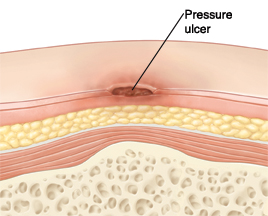
A pressure injury (decubitus ulcer) starts as a red, tender area on skin (pressure sore). It's caused by lying or sitting on a bony area for long periods of time without changing your position. This reduces the amount of blood flow to that part of the skin. Pressure injuries often occur on the lower back, buttocks, or heels. They affect people who spend most or all their time in bed. These pressure injuries take a long time to heal, depending on how big they are and how deep they are.
If a pressure injury becomes infected, it will cause redness in the skin around the pressure injury. Pus will drain from the wound. If not treated early, an infection from a pressure injury can spread to the bloodstream or nearby bone.
Home care
Follow these guidelines to help you or your caregiver care for your wound at home:
-
Look at your pressure injury every day with good lighting to watch for signs of infection. At the same time, check other skin pressure points for early signs of skin changes.
-
Change positions at least every few hours. It will let blood flow to the pressure areas. This is essential for healing to occur. A foam, water, or air mattress or gel pad will help reduce the pressure on the skin.
-
Your health care provider may give you a special skin covering that stays in place on the pressure injury. If a simple bandage is used, change it daily. Clean the pressure injury with sterile saline or another solution your provider tells you to use. Pat dry. Apply any prescribed lotion or cream. Cover with a clean, dry gauze pad.
-
Bed linens should be kept clean and dry.
-
Try to keep from soiling the pressure injury with feces or urine. If this isn’t possible, try to limit the time of contact with the feces or urine. Do this by keeping the wound covered and clean.
Follow-up care
Follow up with your health care provider as advised.
When to get medical advice
Contact your health care provider right away if:
-
There is redness or darkness around the wound that gets worse.
-
There is pain or swelling near the wound that gets worse.
-
Pus drains from the wound.
-
There is foul or increasing odor from the wound.
-
The wound does not get better.
-
You have an unexplained fever of 100.4°F (38°C) or higher, or as directed by your provider.
Online Medical Reviewer: Esther Adler
Online Medical Reviewer: Stacey Wojcik MBA BSN RN
Date Last Reviewed: 03/01/2025
© 2000-2026 The StayWell Company, LLC. All rights reserved. This information is not intended as a substitute for professional medical care. Always follow your healthcare professional's instructions.
Learn More About Health Services at PIH Health
Expert care for every stage of life. Explore the comprehensive services offered at PIH Health.
Explore Services
Get Health Tips & Updates
Sign up for helpful health information, wellness tips and news from PIH Health, delivered straight to your inbox.
SubscribeRelated Articles
Understanding Hyperbaric Therapy
Hyperbaric oxygen therapy (HOBT) is a treatment that is used most often to treat wounds that won’t heal. Learn about why and how it's done.
Puncture Wound
A puncture wound occurs when a pointed object pushes into the skin. It may go into the tissues below the skin, including fat and muscle.
Chin Laceration, Stitches or Tape
A laceration is a cut through the skin. If it 's deep, it may need stitches. Minor cuts may be treated with surgical tape, skin glue, or other basic dressings. Learn how to care for yourself at home.
Wound Check, Infection
A wound that has become infected will not heal properly unless the infection is cleared. Infection in a wound may also spread if it is not treated.

Personalized Care Starts with the Right Provider
Search by specialty, location, and more.
Find A Doctor
Make an Appointment
Your health can't always wait. Schedule an appointment with a PIH Health provider.
Schedule an Appointment
Find a PIH Health Urgent Care Location
Need care today?. Find the nearest PIH Health Urgent Care location.
Find Urgent Care