Standing, sitting, and moving incorrectly all increase your risk of musculoskeletal disorders (MSDs). Why? Because posture problems overwork your body. They strain your muscles and tendons and stress your joints. With a little adjustment, however, you can correct most posture problems. Whatever you do, try to stay in a near-neutral position and work within easy reach. Tasks take less force when you work from a stable base. Take your knowledge of ergonomic principles home with you.
Stay near neutral
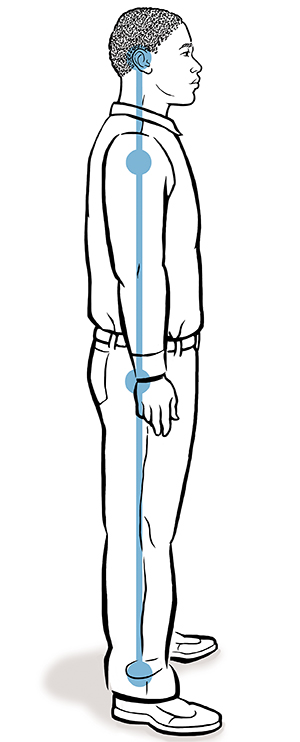
Whether you're standing or sitting, a neutral posture places the least amount of stress on your body.
To find a neutral posture, line up your ears, shoulders, and hips. Keep your head upright and relax while you do this. If you're holding your breath or your shoulders are creeping toward your ears, try again. Your shoulders should be level, with your arms relaxed at your sides. You can rest your body by returning to neutral as often as possible. Other helpful positions and suggestions include:
-
Keep your hands, wrists, and forearms straight and parallel to the floor.
-
Keep your head level, facing forward, and in line with your torso.
-
Your feet should be supported by the floor, and your thighs and hips supported by a padded seat.
-
If you're sitting, it's important that you maintain a neutral posture by following the given suggestions: d
Work within reach
Keep your work within 14 to 18 inches of your body, depending on your size. Reaching too far can be awkward. It also reduces your muscle power, so you need to use more force. Never lock a joint by extending it until it can't go any farther. Also, try not to reach overhead or behind your back if you can help it. If you can't, return to neutral as soon as possible.
Support your body off the job
Have you thought about your posture while you clean the house or watch TV? Anytime you're not using a neutral posture, you might be straining muscles or joints. Just sitting on a sagging sofa every evening could be enough to strain your back. Remember these tips:
-
Check your furniture for ergonomic features, such as adjustable height, lumbar support, and correct cushioning. When relaxing, support your body so you're comfortable and not twisted. On a couch or chair, put a rolled-up pillow behind your back to support it.
-
No matter what you're doing (cooking, cleaning, carpentry), work within reach. Prevent excessive bending and twisting, or using excessive force.
-
You can apply principles of ergonomics in your kitchen as well:
-
Make sure that your mattresses provide adequate support and promote good posture. An old, sagging, lumpy mattress can be doing your body harm. What's best is a comfortable mattress that's firm but has enough cushion to support your body's natural curves. This provides better rest. And it gives your body a chance to recover from the demands of the day.
Online Medical Reviewer: Chris Southard RN
Online Medical Reviewer: Marianne Fraser MSN RN
Online Medical Reviewer: Vinita Wadhawan Researcher
Date Last Reviewed: 10/01/2024
© 2000-2026 The StayWell Company, LLC. All rights reserved. This information is not intended as a substitute for professional medical care. Always follow your healthcare professional's instructions.
Learn More About Health Services at PIH Health
Expert care for every stage of life. Explore the comprehensive services offered at PIH Health.
Explore Services
Get Health Tips & Updates
Sign up for helpful health information, wellness tips and news from PIH Health, delivered straight to your inbox.
SubscribeRelated Articles
Stay Awake Behind the Wheel
When you're behind the wheel, you may believe that you can stop yourself from falling asleep, but you can't. You may not even know you've dozed off. Here are some important tips to help stay alert.
Do You Have a Family Disaster Plan?
Natural disasters can strike quickly and force families like yours to evacuate your neighborhood. But families can and do survive such circumstances if they prepare in advance. These suggestions can help you plan for the worst.
Bullying on the Job
You may find bullying on the playground or in your child's classroom. But what about in your office? About 1 in 4 American workers have been bullied on the job.
Preventing Falls: How to Prepare and What to Do
Falling is not something you want to think about. But it can make a big difference to plan ahead. If you're prepared, you'll know how to get help. And you'll be less likely to panic if you fall. This means you'll be able to do what's needed to get help right away.

Personalized Care Starts with the Right Provider
Search by specialty, location, and more.
Find A Doctor
Make an Appointment
Your health can't always wait. Schedule an appointment with a PIH Health provider.
Schedule an Appointment
Find a PIH Health Urgent Care Location
Need care today?. Find the nearest PIH Health Urgent Care location.
Find Urgent Care